

India’s consumer market has created room for a new generation of homegrown brands that combine modern products with distinctly Indian identities. Among them is Zouk, the first brand of Sea Turtle Private Limited, which has built its presence around bags, wallets and accessories.
Built around the idea of blending contemporary design with Indian cultural influences, Zouk describes itself as a 100% vegan and proudly Indian brand. Its product portfolio spans handmade bags, wallets and accessories, combining functionality with craftsmanship and a distinctly Indian aesthetic. Behind the brand is Sea Turtle Private Limited, a Mumbai-based unlisted company incorporated on 14 June 2016.
Nearly a decade after incorporation, the company has evolved from a young consumer venture into a business with a revenue base exceeding ₹100 crore.
So, as Zouk continues to build its presence, an interesting question emerges:
What could be next for a brand that has already established a meaningful scale in India’s consumer market?
A Five-Year Revenue Story of Strong Expansion
Zouk’s revenue growth has been one of the clearest highlights of its financial performance.
In FY21, the company reported revenue of ₹3.75 crore. A year later, revenue climbed sharply to ₹22.07 crore, marking a 489.08% year-on-year increase. The momentum continued in FY23, when revenue reached ₹47.78 crore, representing another 116.52% growth.
The following year brought another substantial increase. Revenue rose to ₹78.17 crore in FY24, up 63.61% year on year. Then, in FY25, the company crossed the ₹100-crore mark, with revenue reaching ₹126.90 crore, a further 62.33% increase.
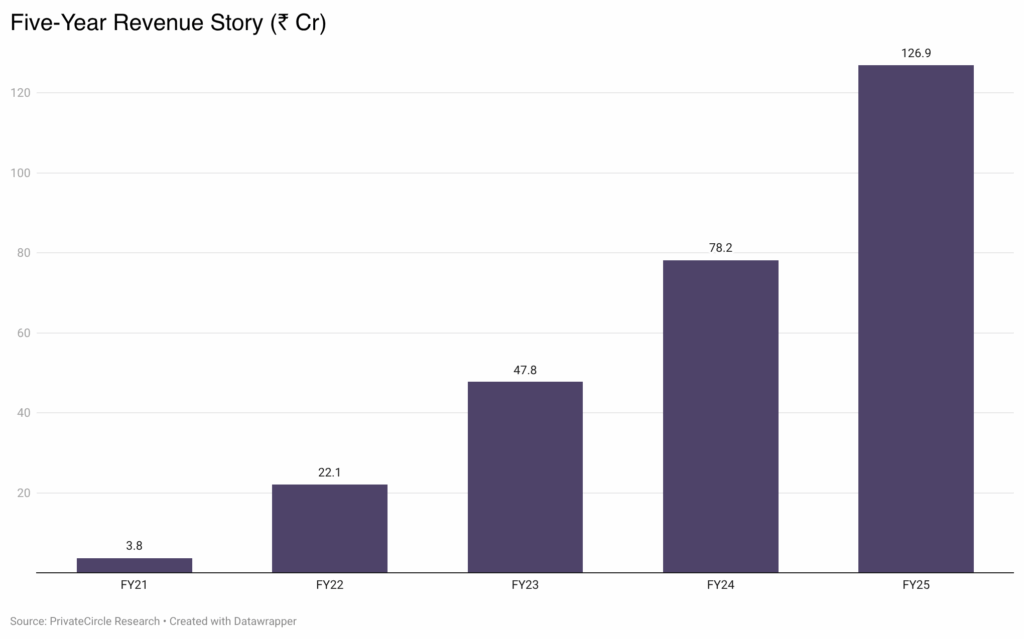
Even more importantly, the company’s reported three-year revenue CAGR stands at 79.16%, highlighting the sustained pace at which the business has expanded.
The pattern is also encouraging because growth has remained strong beyond the initial acceleration phase. After the exceptional growth recorded in FY22 and FY23, Zouk continued to deliver more than 60% annual revenue growth in both FY24 and FY25.
That consistency makes the revenue trajectory particularly interesting.
Crossing the ₹100-Crore Revenue Milestone
FY25 represents an important point in Zouk’s financial journey.
With revenue reaching ₹126.90 crore, the company moved decisively beyond the ₹100-crore threshold. This compares with ₹78.17 crore in FY24, meaning the company added nearly ₹49 crore of annual revenue in a single year.
In percentage terms, that translates into 62.33% year-on-year growth.
Therefore, the company is not merely growing from a small base anymore. Its ability to continue expanding at this scale suggests that the revenue engine has gained considerable momentum.
At the same time, the progression across five years provides useful context:
₹3.75 Cr → ₹22.07 Cr → ₹47.78 Cr → ₹78.17 Cr → ₹126.90 Cr
This progression illustrates a business that has moved rapidly through successive revenue milestones.
Furthermore, the growth has remained broad-based across multiple years rather than being concentrated in just one period. While FY22 and FY23 delivered exceptionally high growth rates, FY24 and FY25 still recorded growth above 60%.
That creates an interesting foundation for the next phase of the company’s financial development.
Gross Profit Provides an Important Perspective
Although PAT remains negative, the company’s gross profit margin has stayed above 55% throughout the five years covered in the report.
The gross profit margin stood at:
- 56.44% in FY21
- 59.57% in FY22
- 56.26% in FY23
- 58.01% in FY24
- 55.39% in FY25
This consistency is an important part of the financial picture.
Despite the significant increase in revenue, the gross profit percentage remained within a relatively narrow range. In other words, the expansion in scale has not been accompanied by a dramatic erosion in gross margin.
That provides a constructive base for the business.
The key question for the next phase, therefore, is less about whether Zouk can generate revenue growth and more about how effectively that growing revenue base can translate into sustainable profitability.
Reading the Ratios: Liquidity Shows Improvement
The company’s liquidity ratios also show a significant improvement by FY25.
Zouk’s current ratio moved from 2.1x in FY21 to 4.3x in FY22, before declining to 1.0x in FY23 and 0.9x in FY24. In FY25, however, the current ratio increased sharply to 4.1x.
Similarly, the quick ratio stood at 2.7x in FY25, compared with 0.4x in FY24. The absolute liquid ratio also improved to 2.2x, compared with 0.2x in FY24.
| Ratio | FY21 | FY22 | FY23 | FY24 | FY25 |
| Current Ratio | 2.1x | 4.3x | 1.0x | 0.9x | 4.1x |
| Quick Ratio | 1.5x | 3.5x | 0.6x | 0.4x | 2.7x |
| Absolute Liquid Ratio | 1.2x | 3.1x | 0.5x | 0.2x | 2.2x |
The FY25 improvement is therefore significant.
What Makes the Next Phase Interesting?
Zouk’s journey so far has several moving parts.
There is the brand itself, a proposition built around vegan products, Indian identity and contemporary design.
There is the company behind it, incorporated in 2016 and still founder-led nearly a decade later.
There is the ownership structure, with the founders collectively holding more than 70% of common shares as of September 2025.
And then there is the financial trajectory, where revenue has expanded rapidly while gross margins have remained above 55%.
The ratios add another layer, showing changes in working capital, liquidity, and the capital structure as the business has scaled.
Taken together, these factors make Sea Turtle an interesting company to watch within India’s growing consumer-brand ecosystem.
The Road Ahead
Zouk has already crossed several important milestones.
From its incorporation in 2016, Sea Turtle has developed its first brand into a business with a revenue base of more than ₹100 crore. Its founders continue to hold a significant ownership position, while the company has also attracted institutional investors over the years.
At the same time, the FY25 numbers show a business operating at a very different scale from where it began.
Revenue has reached ₹126.90 crore, the three-year revenue CAGR stands at 79.16%, gross profit margin remains above 55%, and the FY25 liquidity ratios show a marked improvement.
For Zouk, the next phase could therefore be about building on the foundation already created, expanding the brand, strengthening its operating base, and continuing to evolve alongside India’s increasingly dynamic consumer market.
The company has already built the scale.
What comes next could define the next chapter of Zouk’s growth story.
Conclusion
Sea Turtle Private Limited’s journey reflects the evolution of a homegrown consumer business from its incorporation in 2016 to a company with a ₹126.90-crore revenue base in FY25. With Zouk as its first brand, a strong founder presence, institutional participation, and an expanding operating platform, the company has established a distinctive position in the bags, wallets, and accessories space.
As Zouk enters its next phase, its brand proposition, scale, and financial trajectory will make its continued evolution worth watching.
PrivateCircle helps businesses and investors go beyond surface-level numbers with structured company intelligence, financial analysis, and data-driven insights.