

When a company goes public, most IPO coverage focuses on the IPO size, subscription numbers and listing prospects.
But there is another story worth exploring: who invested in the company before the IPO, who is selling their shares, how much they are cashing out, and how much value they are still holding after the IPO.
The Arcil IPO offers an interesting look at this private-to-public wealth creation journey.
From long-term institutional shareholders such as State Bank of India, GIC Singapore and The Federal Bank to financial investor Avenue Capital Group, the shareholder data highlights how investment timing, holding periods and partial exits can shape investor returns.
Here is a closer look at the Arcil IPO investors, OFS sellers, IPO exit amounts, remaining holdings and return multiples.
Arcil IPO: Key Details
The Arcil IPO is an ₹732.97 crore book-built issue consisting entirely of an Offer for Sale (OFS).
Unlike a fresh issue, Arcil will not receive any new capital from the IPO. Instead, existing shareholders are selling a portion of their holdings to public-market investors.
| IPO Component | Details |
|---|---|
| Total IPO Size | ₹732.97 crore |
| Fresh Issue | Nil |
| OFS Size | ₹732.97 crore |
| OFS Shares | 5.27 crore |
| Price Band | ₹132–₹139 |
| IPO Opens | September 9, 2026 |
| IPO Closes | September 11, 2026 |
| Listing | BSE & NSE |
The OFS component is particularly important for Arcil’s existing shareholders, as it allows them to generate liquidity while, in several cases, continuing to hold a stake in the company after the IPO.
Arcil IPO OFS: Who Is Selling?
Four existing shareholders are participating in the Offer for Sale.
Based on the shareholder data, Avenue Capital Group has the largest IPO exit amount, followed by GIC Singapore and State Bank of India.
Arcil IPO OFS Shareholders
| Investor | Shares Sold in IPO | IPO Exit Amount |
|---|---|---|
| Avenue Capital Group | 2,48,23,910 | ₹345.05 crore |
| State Bank of India | 1,09,63,062 | ₹152.39 crore |
| GIC Singapore | 1,62,44,858 | ₹225.80 crore |
| The Federal Bank Limited | 7,00,116 | ₹9.73 crore |
Together, these shareholders are selling approximately 5.27 crore shares, generating around ₹732.97 crore through the IPO.
Who Is the Biggest Arcil IPO Seller?
Avenue Capital Group stands out as the largest seller in the provided data.
It is selling approximately 2.48 crore shares, generating around ₹345.05 crore in IPO proceeds.
GIC Singapore follows with approximately 1.62 crore shares, translating into an IPO exit amount of around ₹225.80 crore.
Meanwhile, State Bank of India is selling approximately 1.10 crore shares for around ₹152.39 crore.
The Federal Bank is selling a smaller portion of its holding, with approximately 7 lakh shares being sold for around ₹9.73 crore.
Arcil IPO Investors: How Much Did They Make?
IPO exit proceeds tell only one part of the story.
To understand the wealth creation for Arcil investors, it is useful to compare their initial investment with the total value of their investment.
The provided shareholder data defines the Value of Investment as the combination of the current value of the remaining stake, pre-IPO exit value and IPO exit value.
Arcil IPO selling shareholders and investor returns
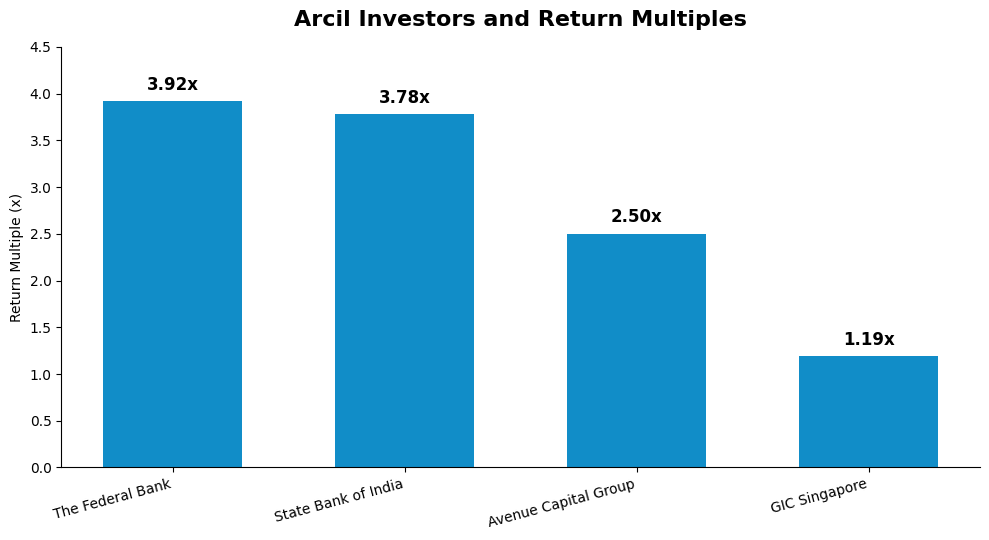
The Federal Bank: 3.92x Return Multiple
One of the standout figures in the Arcil shareholder data belongs to The Federal Bank Limited.
The bank’s first investment dates back to May 2003.
An investment of approximately ₹14.67 crore is represented by a total investment value of around ₹57.54 crore, resulting in a reported 3.92x return multiple.
The Federal Bank is also selling approximately 7 lakh shares in the IPO for around ₹9.73 crore.
Importantly, however, the bank is not fully exiting.
After the IPO, the provided data shows approximately 34.39 lakh shares remaining, with a post-IPO stake value of around ₹47.80 crore.
This makes the Arcil IPO a partial liquidity event rather than a complete exit for the bank.
State Bank of India: 3.78x Return Multiple
State Bank of India is another long-term Arcil shareholder.
Its first investment dates back to May 2003, making it one of the earliest investors among the shareholders covered in the data.
SBI invested approximately ₹23.83 crore.
Its total investment value is now shown at approximately ₹90.06 crore, translating into a reported 3.78x return multiple.
SBI is selling approximately 1.10 crore shares through the IPO for around ₹152.39 crore.
However, SBI continues to hold approximately 5.39 crore shares after the IPO.
The remaining stake is valued at approximately ₹74.86 crore based on the provided data.
So, like Federal Bank, SBI is monetizing part of its investment while retaining a significant stake in Arcil.
Avenue Capital Group: ₹314.93 Crore Investment Value
Avenue Capital Group has the largest investment value among the shareholders in the provided data.
Its first investment dates back to March 2019, with an investment amount of approximately ₹126.01 crore.
The total value of the investment is shown at approximately ₹314.93 crore, resulting in a reported 2.50x return multiple.
Avenue Capital Group is selling approximately 2.48 crore shares in the IPO, generating around ₹345.05 crore in IPO proceeds.
But the investor is not exiting completely.
The provided data shows approximately 20.17 crore shares remaining after the IPO, with a post-IPO stake value of around ₹280.42 crore.
This means the IPO allows Avenue Capital Group to realize substantial liquidity while continuing to participate in Arcil’s future growth.
GIC Singapore: 1.19x Return Multiple
GIC Singapore also features prominently among Arcil’s long-term shareholders.
Its first investment dates back to December 2008, with an investment amount of approximately ₹27.02 crore.
The provided data shows a total investment value of approximately ₹32.13 crore, resulting in a reported 1.19x return multiple.
GIC Singapore is selling approximately 1.62 crore shares in the IPO, generating around ₹225.80 crore.
The data also shows approximately 1.59 crore shares sold before the IPO.
Following these transactions, the provided shareholder data shows no remaining shares.
Therefore, unlike Avenue Capital Group, SBI and Federal Bank, GIC Singapore’s position represented in the data is effectively fully monetized.
Not All Arcil Investors Have the Same Returns
One of the most interesting aspects of the Arcil shareholder data is the difference in return multiples among investors.
The reported multiples range from 1.19x to 3.92x.
For example:
- The Federal Bank: 3.92x
- State Bank of India: 3.78x
- Avenue Capital Group: 2.50x
- GIC Singapore: 1.19x
This difference highlights an important principle of private-market investing:
The return on an investment depends not only on the company’s growth, but also on when the investor entered and how long the investment was held.
Why Early Arcil Investors Have Different Return Multiples
The Arcil shareholder data shows that investors entered the company at very different points in time.
There are several reasons why this matters.
1. Long Holding Periods
SBI and Federal Bank entered Arcil as early as 2003.
This gives them a much longer holding period compared with Avenue Capital Group, which invested in 2019.
2. Entry Valuation Matters
Investors entering at different stages can acquire shares at different valuations.
Therefore, even if shareholders own stakes in the same company, their return multiples can vary significantly.
3. Partial Exits Change the Wealth Picture
The IPO does not mean every shareholder is selling everything.
For investors retaining shares, the total investment value includes both the cash realized through exits and the value of the remaining stake.
4. IPOs Create Liquidity
The public listing gives existing shareholders a new avenue to monetize their investments.
At the same time, shareholders that retain stock can continue participating in the company’s future performance.
Arcil IPO: Selling Some, Staying In
An important point in analysing Arcil’s IPO is that selling shares in the IPO does not necessarily mean an investor has completely exited the company.
The shareholder data makes this particularly clear.
Existing shareholders can:
- Sell a portion of their holdings
- Retain shares after the IPO
- Realize partial liquidity
- Continue participating in future growth
In the provided data, Avenue Capital Group, SBI and Federal Bank continue to hold shares after the IPO.
This makes the Arcil IPO more than just an exit event.
It is a partial liquidity event and a transition from private ownership to public-market ownership.
Arcil IPO: Who Benefits the Most?
Looking at the available shareholder data, the investor with the highest reported return multiple is The Federal Bank at 3.92x.
State Bank of India follows closely at 3.78x.
However, looking at absolute investment value presents a different picture.
Avenue Capital Group has the highest reported total investment value at approximately ₹314.93 crore.
Arcil IPO Investor Scorecard
| Investor | Return Multiple | IPO Exit | Remaining Stake Value |
|---|---|---|---|
| The Federal Bank | 3.92x | ₹9.73 Cr | ₹47.80 Cr |
| State Bank of India | 3.78x | ₹152.39 Cr | ₹74.86 Cr |
| Avenue Capital Group | 2.50x | ₹345.05 Cr | ₹280.42 Cr |
| GIC Singapore | 1.19x | ₹225.80 Cr | Nil |
This shows that return multiple and absolute wealth are two different measures of investor success.
Arcil IPO: IPO Exit vs Total Investment Value
The Arcil shareholder data also shows an important distinction between IPO exit value and total investment value.
For Avenue Capital Group, the IPO exit amount is approximately ₹345.05 crore, while the total value of investment is approximately ₹314.93 crore based on the provided data.
For SBI, the IPO exit is approximately ₹152.39 crore, while its reported total investment value is around ₹90.06 crore.
These figures should therefore be read according to the definitions in the underlying shareholder dataset, rather than treating the IPO exit amount alone as the investor’s complete wealth realization.
The broader point is that IPO proceeds are only one part of the investor wealth story.
What the Arcil IPO Investor Data Tells Us
1. Long-Term Investors Can Create Significant Value
SBI and Federal Bank entered Arcil in 2003 and have generated reported multiples of 3.78x and 3.92x, respectively.
2. Investment Timing Matters
Investors entering at different stages can experience very different outcomes.
The Arcil data shows how a 2003 entry and a 2019 entry can result in different return multiples.
3. IPOs Can Provide Partial Liquidity
The Arcil IPO allows existing shareholders to sell shares without necessarily giving up their entire position.
4. Remaining Stakes Still Matter
For shareholders that continue holding shares, the value of their post-IPO stake remains an important part of the wealth-creation story.
5. OFS Shows Who Is Monetizing
Because the Arcil IPO is entirely an OFS, the IPO provides a direct window into which existing shareholders are choosing to monetize their holdings.
Arcil IPO: The Bigger Private-Market Story
The Arcil IPO is more than a public listing.
It represents the transition of a company from long-term private ownership to public-market participation.
The journey can be broadly understood as:
Early Investment → Long-Term Ownership → Business Growth → IPO → Partial Liquidity → Continued Ownership
Every shareholder can take a different path through this journey.
Some investors may choose to monetize a portion of their holdings.
Others may sell more aggressively.
And some may continue holding their shares after listing to participate in future growth.
That trade-off is clearly visible in the Arcil shareholder data.
Conclusion: The IPO Is Not Always a Full Exit
The Arcil IPO may attract attention because of its ₹733 crore OFS and upcoming public-market debut.
But the shareholder data reveals a deeper story.
Avenue Capital Group, State Bank of India and The Federal Bank are using the IPO to monetize portions of their holdings while continuing to retain stakes in Arcil.
At the same time, GIC Singapore has monetized its position through the IPO and an earlier sale reflected in the provided data.
The reported return multiples range from 1.19x to 3.92x, showing how investment timing and holding periods can influence outcomes.
The biggest lesson is clear:
An IPO can create liquidity without marking the end of an investor’s journey.
For investors, founders and private-market professionals, understanding who invested, when they invested, how much they invested, who is selling, how much they are selling and what they continue to hold provides a much deeper view of an IPO than listing-day performance alone.
PrivateCircle helps investors decode unlisted companies, shareholders, investments and ownership data before they become public-market stories. The Arcil IPO shows why understanding who invested, when they invested, who is selling and who is staying invested can reveal the real wealth-creation story behind an IPO.