
Introduction to the Industry
India’s snacking market is entering a new phase as consumers increasingly look beyond taste and convenience. They are paying closer attention to ingredients, preparation methods, nutrition, quality and value. As a result, the traditional snack aisle is gradually making room for brands that combine familiar Indian flavours with stronger quality and ingredient propositions.
Moreover, rising urbanisation, changing lifestyles and the convenience of online and quick-commerce channels are creating new opportunities for emerging food brands. Consumers want snacks that fit busy routines, while still feeling indulgent and familiar. Consequently, brands that can balance taste, accessibility and perceived quality are gaining attention.
At the same time, India’s packaged-food ecosystem is becoming more competitive. Established FMCG companies, regional manufacturers and digitally native brands are all competing for the same consumer. Therefore, strong distribution, repeat purchases, product innovation and brand trust are becoming just as important as marketing.
In this environment, founder-led brands can build an advantage by combining category expertise with a clear consumer proposition. Let’s Try is an example of a homegrown snacking brand that has attracted both consumer attention and a diverse set of investors.
About the Company
Let’s Try is a homegrown Indian snacking brand founded by Nitin Kalra. The company operates in the packaged-snacks category and offers a broad portfolio spanning products such as namkeens, wafers, cookies, cakes and sweets. Its positioning centres on making quality snacking more accessible while offering products designed for modern consumer preferences.
The brand has also built visibility through its founder-led story and its appearance on Shark Tank India. Subsequently, institutional and strategic investors joined its shareholder base, giving the business access to capital and industry networks as it expanded its presence across online and offline channels.
From an ownership perspective, the company is particularly interesting because the cap table combines meaningful founder ownership with participation from investment firms, corporate investors and an individual strategic investor. This mix provides a useful lens into how a growing consumer brand can evolve from founder-led ownership toward a broader institutional shareholder base.
Let’s Try Investor and Ownership Analysis
Key Ownership Insights
- Nitin Kalra is the largest individual shareholder in the table, with a 32.83% stake, giving the founder a significant continuing interest in the company’s growth.
- Neelam Kalra and Chitra Gupta each hold 16.49%, making the combined holding of these three individual shareholders 65.81%.
- Z Nation Lab holds 9.76%, making it the largest named institutional or investment vehicle in the table.
- SWC Global holds 8.03% and represents another important institutional investor in the ownership structure.
- 100Unicorns (9Unicorns) owns 5.16%, while Wipro Enterprises Private Limited holds 4.32%, adding further strategic and institutional participation.
- Venture Catalysts owns 2.62%, while Aman Gupta holds 1.76%, reflecting the participation of both investment platforms and an individual strategic investor.
- Overall, the cap table shows a strong founder and related-shareholder presence alongside a diversified group of institutional and strategic investors.
Shareholding Structure (May 2026)
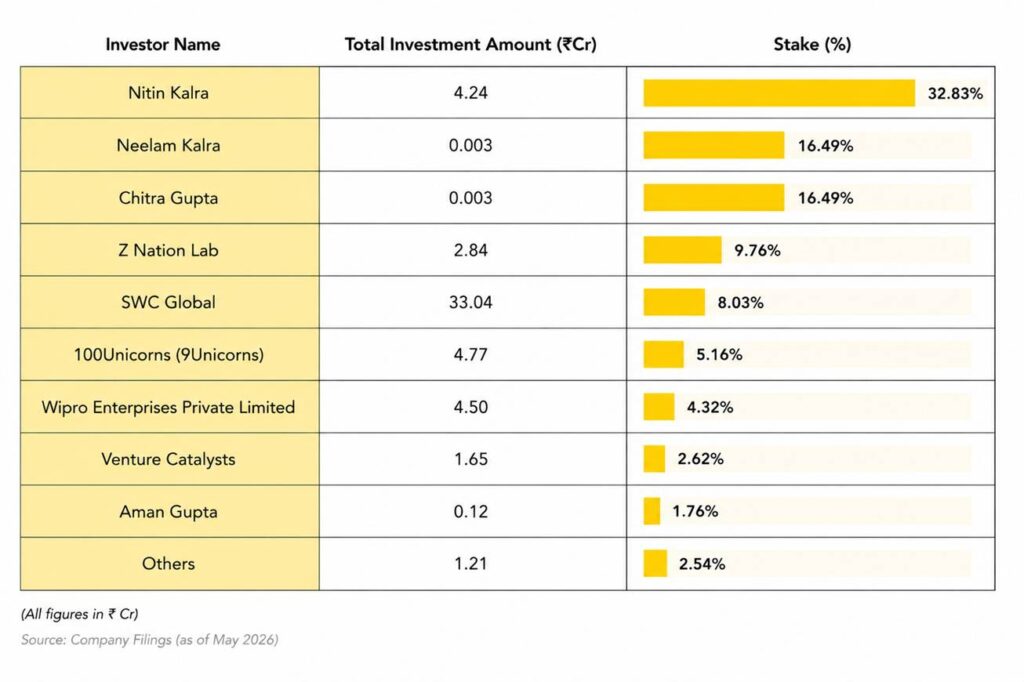
Note: Investment amounts and diluted ownership percentages are based on the company filings reflected in the provided ownership table as of May 2026. ESOP shares are excluded. Where secondary transaction values were unavailable, the values are based on the nearest available primary transaction price from the closest filing.
What the Ownership Structure Tells Us
The ownership table highlights an important feature of Let’s Try: founder and related individual shareholders continue to hold a substantial portion of the company. Nitin Kalra’s 32.83% stake, together with the holdings of Neelam Kalra and Chitra Gupta, brings the combined ownership of these three shareholders to 65.81%. This indicates that the business retains a strong founder and promoter-linked ownership base even after bringing in multiple outside investors.
At the same time, the presence of SWC Global, Z Nation Lab, 100Unicorns, Wipro Enterprises Private Limited and Venture Catalysts shows that the company has attracted a diversified investor group. These investors can potentially contribute more than capital through networks, distribution expertise, consumer-sector knowledge and strategic relationships.
Another notable point is the spread of ownership across different investor types. The cap table includes investment platforms, a corporate investor and an individual investor. Such diversity can strengthen the company’s access to different forms of support as it moves through its next stage of growth.
The ₹52.38 crore total investment amount shown in the table also provides a useful view of the capital associated with the identified shareholders. However, investment amount should not be confused with current company valuation or the market value of each holding.
Current Business Trends and Future Outlook
India’s packaged-snacking category is becoming increasingly competitive, but the long-term opportunity remains significant. Consumers continue to seek convenient foods while becoming more conscious of quality and ingredients. This creates room for brands that can deliver familiar flavours while differentiating themselves through product quality, packaging, distribution and brand positioning.
Let’s Try’s growth opportunity is also supported by the continued expansion of omnichannel food retail. Online marketplaces and quick-commerce platforms can help emerging brands reach consumers quickly, while general trade, modern trade and other offline channels can build wider household penetration. A balanced channel strategy can therefore become an important growth lever.
Several trends are likely to shape the company’s next phase:
- Growing demand for convenient and better-positioned snack options.
- Expansion of premium and differentiated regional-flavour products.
- Greater consumer attention to ingredient quality and product claims.
- Rapid growth of quick commerce and digital discovery for packaged foods.
- Rising importance of offline distribution across Tier 2 and Tier 3 markets.
- Continued investor interest in scalable Indian consumer and FMCG brands.
- Greater use of founder-led storytelling and digital communities to build trust.
Major Challenges and Risk Factors
Industry Challenges
- Intense competition from established FMCG companies and emerging snack brands.
- High pressure on pricing, promotions and customer acquisition.
- Rising expectations around product quality, ingredient transparency and consistency.
- Supply-chain and manufacturing complexity as distribution expands.
- The challenge of maintaining attractive unit economics while scaling nationally.
Company-Specific Challenges
- Scaling manufacturing and distribution without compromising product consistency.
- Maintaining a differentiated brand proposition as competition increases.
- Managing working capital and inventory efficiently across a growing product portfolio.
- Building sustainable repeat purchases rather than relying only on promotional or founder-led demand.
- Balancing rapid expansion with disciplined execution and long-term profitability.
Conclusion
Let’s Try’s ownership structure offers a clear picture of a consumer brand moving from founder-led entrepreneurship toward a more diversified investor base.
Nitin Kalra remains the largest individual shareholder with a 32.83% stake, while Neelam Kalra and Chitra Gupta each hold 16.49%. Together, these three shareholders account for 65.81% of the ownership shown in the table.
Meanwhile, participation from Z Nation Lab, SWC Global, 100Unicorns, Wipro Enterprises Private Limited, Venture Catalysts and Aman Gupta demonstrates the breadth of investor interest around the brand.
More broadly, the company’s opportunity lies in India’s expanding packaged-snacking market, where convenience, quality, distribution and consumer trust are increasingly important. If Let’s Try can continue to scale its product portfolio and distribution while protecting its brand proposition, the ownership base provides a strong foundation for its next stage of growth.
For investors and market observers, the Let’s Try cap table is therefore more than a list of shareholders. It reflects the combination of founder conviction, institutional capital and strategic participation that is shaping the next generation of Indian consumer brands.
PrivateCircle enables investors and market participants to access deeper insights into unlisted companies, ownership structures, investments and business developments.